
The quality problem: You don't need more governance. You need to see what's happening.
You have change control. You have milestone reviews. You have steering committees and vendor scorecards and close-out processes.
The problem isn't that these don't exist. The problem is they don't work at scale - and they only cover what someone remembered to register.
When you're running eight workstreams across three system integrators plus contractors, the governance that worked for a single engagement breaks down. Information gets filtered before it reaches you. Small changes accumulate without triggering any formal process. Things fall between vendors and nobody owns them.
By the time something surfaces at a steering committee, it's already a problem.
What actually goes wrong
Small changes add up. Big scope changes get caught. They go through change control, there's a paper trail. But most changes aren't big. They're small adjustments that don't trigger formal approval. A tweak to the data model. An extra integration point. A revised timeline for one deliverable.
Over six months, a programme might see dozens of these. Some get logged, most don't. Each seems minor. Nobody sees the accumulation until the quarterly review reveals the project is £400k over and eight weeks behind - and there's no single decision point to trace it back to.

The multi-vendor blind spot. One integrator is doing the platform. Another is handling change management. A boutique is doing data migration. Contractors are filling gaps. Each reports to a different sponsor. Each has their own status reporting. When something falls between them, it's everyone's problem and nobody's problem.
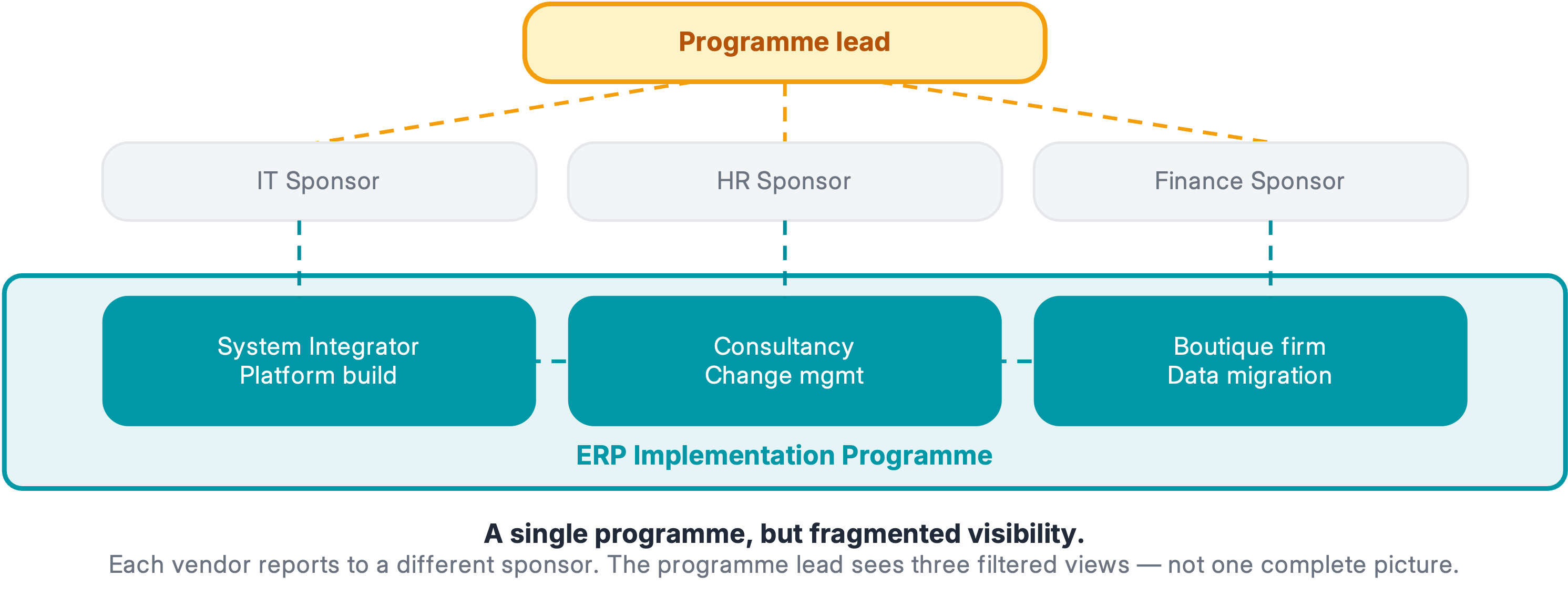
BCG found that 84% of companies running digital transformations were frustrated by coordination challenges between and across vendors. Not because of any single vendor's performance - because nobody had the consolidated view.
Filtered information. Status reports go through layers of interpretation before they reach you. PMs filter because they're trying to solve problems before escalating - which is often the right thing to do. The issue is you can't tell the difference between "handled" and "hidden." The information you need exists. It's just not reaching you unfiltered.
Perfunctory close-outs. You have vendor scorecards. By the time an engagement ends, the team has moved on. The PM is on another project. The evaluation is a box-ticking exercise. You start the next engagement with the same vendor having learned nothing from the last one.
Knowledge transfer that never quite happens. Handover plans exist on paper. But when the engagement ends, documentation is thin, training is rushed, and six months later you're either calling them back or rebuilding from scratch.
What would actually help
Not more governance. Better visibility into what's actually happening - even when people don't follow the process.
Seeing the accumulation before it's too late. You can't force people to log every informal change. But you can see the symptoms: burn rate climbing faster than milestones are completing. Invoices showing 60% more spend this month than last month. A team that was supposed to be eight people now billing for fourteen. The discrepancy surfaces even when nobody logged the cause.
One view across all engagements - without relying on people to register them. Every tool promises consolidated visibility. The difference is whether you get it only for engagements someone remembered to set up, or for everything - including the ones that started without proper approval and the extensions that were agreed informally. When engagements are discovered from invoices rather than registered manually, nothing slips through because someone forgot to register it.
Ownership that's visible and accountable. Not just "this project has a sponsor" but a clear record of who owns what, linked to the initiatives they support. When an engagement has no clear owner, that's visible. When something falls between vendors, there's a place to assign it.
A path from problem to resolution. Visibility is only useful if you can act on it. When you see a discrepancy, you need to assign someone to investigate, track that it gets resolved, and keep a record of what was found. Not just "there's a problem" but a clear path to "someone is responsible for fixing it."
Gaps surfaced early. If an engagement is missing governance steps that similar projects typically have - transition milestones, change control checkpoints, documentation deliverables - it's flagged as a risk before it becomes a problem. Based on proven best practice for the project type, configurable to your own methodology.
Close-out data that means something. Not a scorecard filled out because it's required. Structured data on what was delivered, what wasn't, how scope changed, and whether you'd use them again. Patterns across suppliers emerge over time - which firms consistently deliver, which consistently overrun.
How Scopecreeper helps
This is what Scopecreeper is built for. Not another PMO tool that requires your teams to enter data. A layer that sits on top of what you already have and surfaces what's actually happening.
- Engagements discovered from invoices, not registered manually. If money is being spent on consultants, it's visible - even if nobody set up the project. Even if it's only paid after completion, someone sees it happened and can ensure proper process is followed next time.
- Discrepancies surfaced automatically. When burn rate exceeds plan, or milestones slip while spend continues, the gap is visible. You see "we've consumed 70% of budget but only completed 40% of milestones" without waiting for someone to tell you.
- Interventions tracked with clear ownership. When a discrepancy surfaces, it creates an activity with someone accountable for following up. A deadline, a record of what was found, a path to resolution.
- Missing elements flagged as risks. If an engagement is missing a transition plan, or a change control milestone, or a documented SOW, it's surfaced. Checked against best practice for the project type, and against your own governance requirements.
- Supplier performance captured consistently. End-of-engagement ratings, delivery against scope, timeline performance. Over time, patterns emerge - not opinions, data.