
Catching problems before the final invoice
Early warning signs that a consulting engagement is going off track
Most consulting problems are discovered too late. The budget extension arrives after the money is spent. The missed deadline is announced after weeks of optimistic updates. The quality issues emerge when the final deliverable lands.
But problems don't appear from nowhere. There are almost always warning signs earlier. The question is whether anyone is watching.
Why problems get discovered late
Consultant optimism: Consulting teams are trained to be positive. They believe they can catch up. They don't want to alarm the client. Bad news gets delayed.
Busy internal sponsors: The people overseeing consulting engagements have day jobs. Detailed tracking falls down the priority list.
No systematic tracking: Without a system connecting invoices to milestones to budgets, problems hide in the gaps.
Internal issues stay invisible: A sign-off pending for three weeks doesn't look like a "project risk." But it is.
The warning signs
Budget burn vs. progress: The most reliable indicator. 50% through budget but 30% through milestones = problem. It doesn't matter what the status update says.
Milestone slippage: One missed deadline can be explained. Two is a pattern. Track not just whether milestones are complete, but how far they've slipped.
Internal blockers accumulating: Sign-offs pending, stakeholders unavailable, reviews scheduled but not completed. These might not look like project risks, but they cause timeline extensions that cost money.
Team composition drift: Senior consultants replaced by juniors. Team size changing without discussion.
Invoice anomalies: Invoices arriving earlier than expected, for more than expected, or with line items that don't match agreed phases.
No transition plan: Implementation nearing completion, but no internal team identified to take over. This predicts an extension.
What "early" actually means
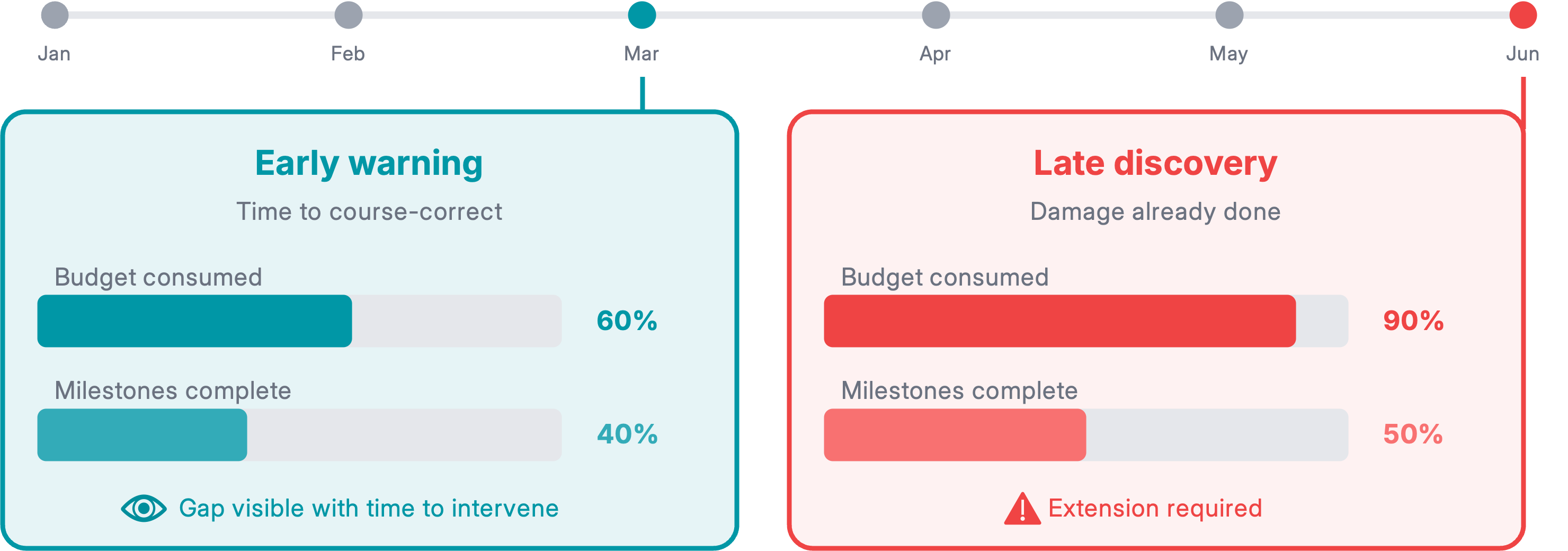
Early warning doesn't mean predicting the future. It means seeing the present clearly.
- Late discovery: "We need a budget extension" (after 90% of budget is spent)
- Early warning: "Budget is 60% consumed but only 40% of milestones complete" (while there's time to act)
The information might be the same. The difference is when you see it.
How leading companies approach this
Organisations that catch problems early do a few things consistently:
- Track internal dependencies: Not just consultant deliverables, but client-side actions. If Legal needs to sign off, that's tracked as actively as any milestone
- Track spend against budget as invoices arrive: Not just at quarter-end when the money is already spent
- Plan transitions early: Internal resourcing for post-implementation is agreed before the project is halfway done
- Escalate promptly: Issues are raised when small, not when they've become crises
How Scopecreeper enables early warning
- Connecting invoices to milestones: Every invoice matched to its engagement, so you always know spend vs. progress
- Tracking against SOW: Milestones and budgets from your statement of work become the baseline
- Flagging automatically: When milestones slip or budget accelerates, alerts are triggered
- Internal readiness tracking: When a milestone depends on an internal action, we track it. Pending sign-offs become visible
- Intervention tracking: When issues are identified, create intervention activities to track them through to resolution
The goal isn't to add process. It's to make the information you need visible.