
Scope creep: Causes, examples, and how to catch it early
It's two weeks before the deadline. The consulting team requests a budget extension. The project that was meant to cost £200k is now at £280k, with another £50k "recommended" to finish properly.
According to PMI's Pulse of the Profession research, 52% of projects experience scope creep - up from 43% five years earlier. Despite organisations investing more in productivity tools and AI than ever, it's getting worse, not better.
What scope creep actually is
Scope creep is the gradual expansion of a project beyond its original boundaries. It rarely happens all at once. Instead, it accumulates through small additions that each seem reasonable in isolation.
The PMI defines scope as "the extent of what a project will produce and the work needed to produce it." Scope creep happens when that extent grows without corresponding adjustments to budget, timeline, or resources.
The four types of scope creep
Feature creep: More deliverables than originally agreed. The strategy project that now includes an implementation roadmap. The system design that now includes training materials. Each addition might make sense, but they add up.
Effort creep: Same deliverables, more work to produce them. The "simple" integration that required custom development. The stakeholder interviews that doubled because everyone wanted to be included. The scope hasn't officially changed, but the effort has.
Silent creep: When the consulting team absorbs the overrun rather than flagging it. They work longer hours, cut corners on quality, or delay telling you there's a problem. You don't see it until it's too late.
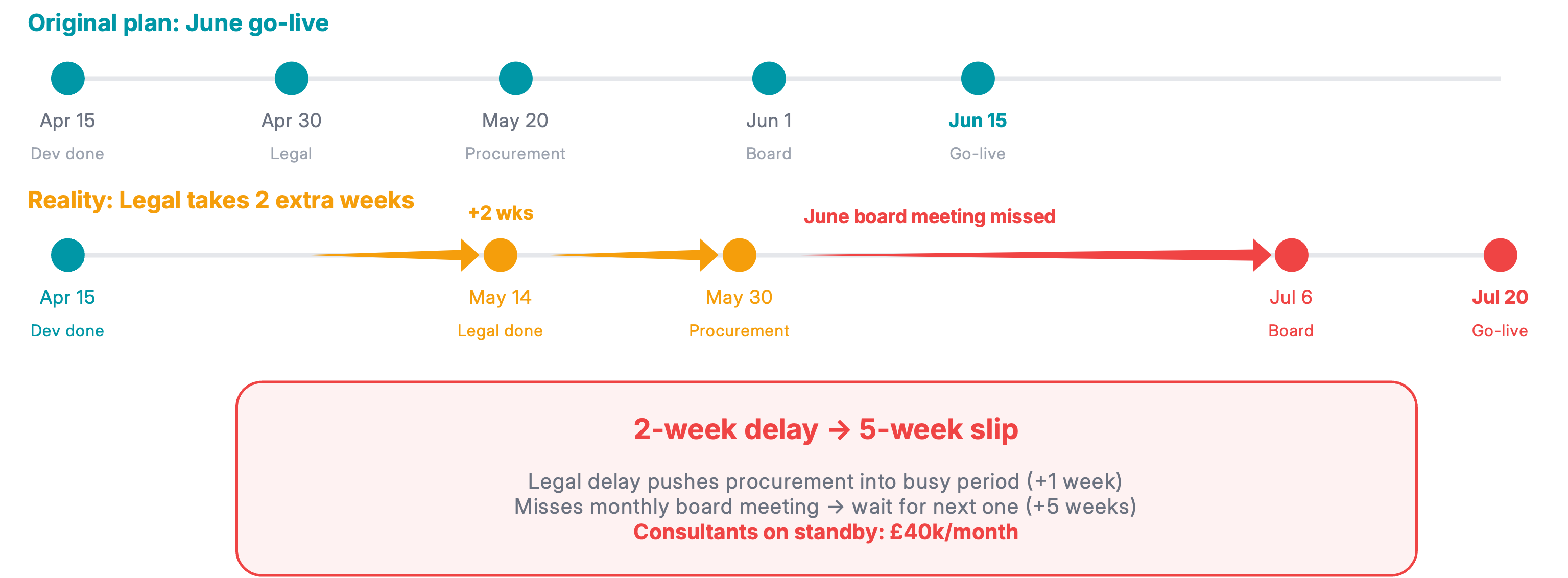
Delay creep: When internal blockers cause timeline extensions that aren't the consultant's fault. A sign-off that takes three weeks instead of three days. A stakeholder who's unavailable for a critical review. A monthly approval board that gets skipped. These delays compound: what was meant to be approved in May slips to June, then July (no board meeting - summer holidays), then August. Meanwhile, the consulting team is either stood down (and you lose momentum) or kept on retainer (and you pay for waiting).
How delays cascade
Why scope creep happens
Vague statements of work: When deliverables aren't clearly defined, there's room for interpretation. "Strategy recommendations" can mean a 10-slide deck or a 100-page report.
No milestone tracking: Without clear checkpoints, it's hard to know if you're on track until you're clearly off it.
Informal change requests: The "while you're at it" additions that happen in meetings. Each seems small. Nobody tracks the cumulative impact.
Organisational readiness gaps: The client side isn't ready to play their part. Data isn't available when needed. Subject matter experts are pulled onto other priorities. The steering committee keeps rescheduling. The consultants wait - and the meter runs.
No handover plan: The implementation is complete, but nobody on the client side is ready to take over. The consultants stay on "to support the transition" - and the engagement extends month after month. A utility provider found multiple projects running without implementation budgets at all - the strategy work was funded, but nobody had planned for what came next.
Real-world examples
The presentation that became a strategy project: A company hired consultants to prepare a board presentation on digital transformation. During the work, the CEO asked for "a bit more depth" on the competitive landscape. Then the CFO wanted financial projections. Then operations wanted an implementation timeline. The original £30k presentation became a £120k strategy project. Multiply this across dozens of similar "small" engagements, and you're looking at significant unplanned spend.
The approval cascade: A consulting deliverable needed sign-off from Legal before going to the investment committee. Legal had concerns that required a two-week revision. The revised version missed the May committee. June's committee was cancelled. July's was inquorate. The deliverable was finally approved in September - four months late. The consultants were kept on standby throughout, at £40k per month.
The implementation with no home: A systems integrator delivered a new platform on time and on budget. But the client hadn't hired the team to run it. "Could you stay on for a month to help with the transition?" A month became three. Three became six. The consultants were doing BAU work at consulting rates because nobody else was ready to take over.
Warning signs to watch for
- Budget burn rate ahead of progress: 60% of budget spent, 40% of milestones complete
- Milestone delays without clear reasons: Deadlines slipping with vague explanations
- Scope changes without budget changes: New deliverables added, no corresponding adjustment
- Internal blockers accumulating: Sign-offs pending, stakeholders unavailable, reviews delayed
- Vague extension requests: "We need another month to wrap up" without specific deliverables
- No transition plan in sight: Implementation nearing completion but no internal team ready to take over
How Scopecreeper helps
Scopecreeper doesn't replace good project governance. But it makes problems harder to miss.
- Budget tracking: Invoices matched against agreed budgets, with alerts when spend is ahead of plan
- Milestone monitoring: Clear view of what's complete, in progress, and overdue
- Internal readiness tracking: When a milestone depends on an internal sign-off or review, we flag it. If approval has been pending for two weeks, you see it before it causes a cascade
- Intervention activities: When issues are identified, track the actions taken to resolve them through to completion
The goal is simple: see problems before the final invoice arrives, not after.