
What good looks like: Consulting governance without the overhead
Most companies know they should manage their consulting spend better. Fewer know what that looks like in practice.
There's a common fear that "better governance" means "more process." More forms. More approvals. More meetings. More work for everyone.
But good consulting management isn't about adding bureaucracy. It's about having the right information when you need it, without creating work to get it there.
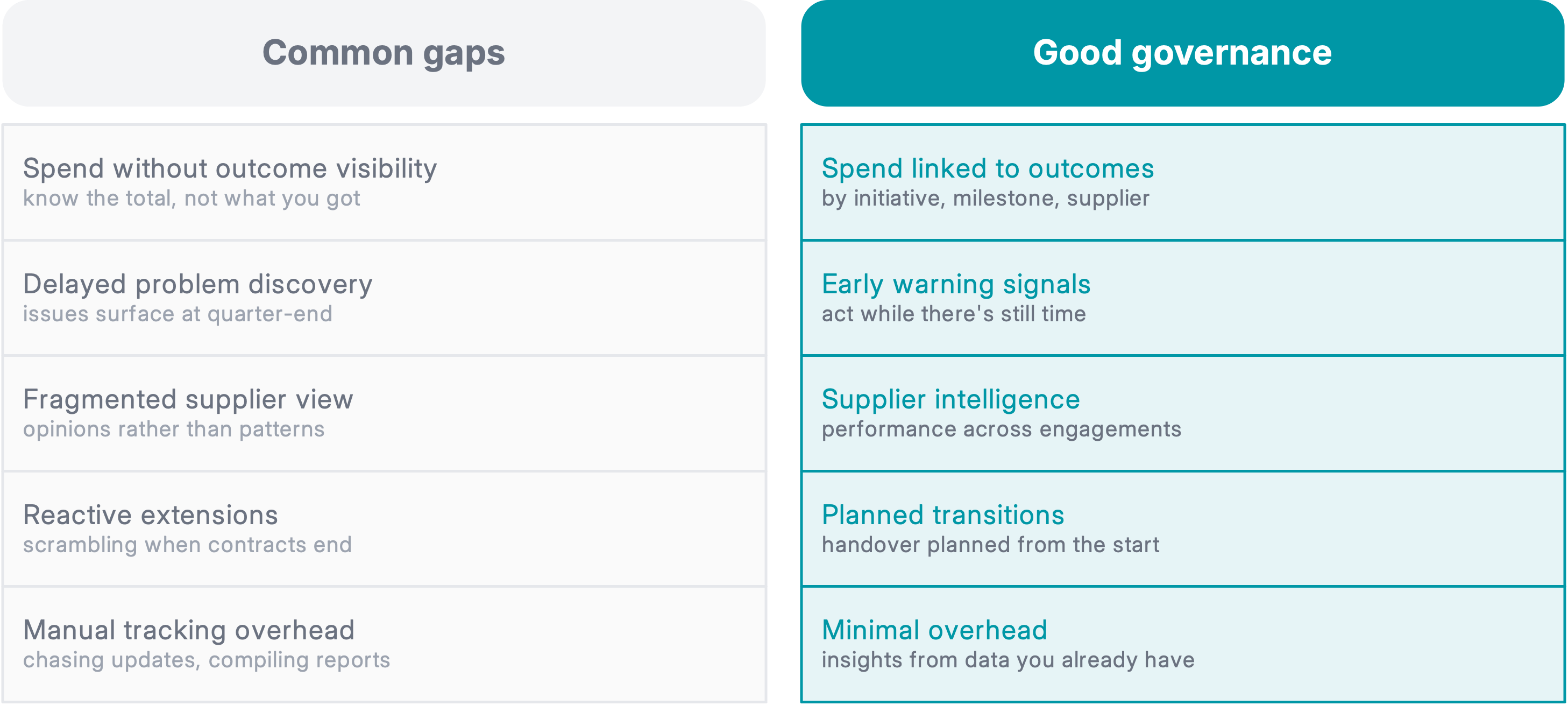
What bad looks like
- Total-only visibility: You know what you spent. You don't know what you got
- Reactive management: Problems discovered when budget extensions are requested, not before
- Quarterly rearview: Spend reports arrive after the money is spent
- No supplier intelligence: Each engagement treated as a one-off. No systematic comparison
- Internal blockers invisible: Sign-offs and reviews pending for weeks, but nobody tracking them as risks
- Extensions by default: Consultants stay on because there's no plan for handover
What good looks like
Outcome-linked visibility: Spend connected to strategic priorities. You know not just how much went to consultants, but which initiatives that money supported and whether they're on track.
Early warning: When a milestone slips or budget accelerates, you know immediately. When an internal sign-off is blocking progress, it's visible.
Supplier intelligence: Performance compared across suppliers. Which firms deliver? Which overrun? What are you paying for different seniority levels?
Planned transitions: Internal resourcing for post-implementation agreed early. Engagements end when they should, not when someone finally takes over.
Minimal overhead: Project managers work largely as they always have. They only provide input when there's a genuine gap - not routine status reports that duplicate what's already visible from documents.
How leading companies get there
The organisations that manage consulting well share a few practices:
1. They build on existing data. Invoices and statements of work exist whether you track them or not. Good governance extracts value from these rather than creating new data collection.
2. They make internal dependencies visible alongside external ones. A sign-off from Legal is as much a milestone as a consultant deliverable. If it's blocking progress, it's visible.
3. They plan transitions from the start. Who will run the system after go-live? Who will own the process after the consultants leave? These questions are answered during planning, not at the end.
4. They treat extensions as new decisions. Continuation isn't automatic. Each extension is justified against clear criteria.
5. They focus on exceptions. Most engagements proceed as planned. Governance highlights the ones that don't, not requiring equal attention to everything.
The outcomes
Organisations that implement these practices see measurable results. A major retailer eliminated €4M in duplicates and unnecessary extensions in their first year. A utility provider achieved 10% spend reduction year-on-year. A large manufacturer shifted volume to better-performing specialists and reduced spend by 20%+ with no drop in delivery quality.
- Better supplier relationships: Data-informed conversations about performance and value
- Faster intervention: Problems addressed while small, including internal blockers
- Cleaner endings: Engagements conclude when the work is done, not when someone finally takes over
- Reduced waste: Less money lost to scope creep, duplicate work, and avoidable extensions
- Confident reporting: Clear, accurate information whenever stakeholders ask
How Scopecreeper helps
Scopecreeper is built around these principles. Good consulting governance shouldn't require a new team or a heavy implementation. It should emerge from data you already have, surfaced intelligently.
- Invoices in, insights out: Upload invoices and we automatically build engagement profiles and track spend
- SOW as baseline: Upload statements of work and we extract milestones and budgets to track against
- Internal readiness tracking: When milestones depend on internal actions, we track them. Pending sign-offs become visible risks
- Exception-based alerts: Automatic flags when something needs attention
- Intervention tracking: When issues arise, track resolution through to completion
- Benchmarking built in: Compare suppliers, rates, and performance across your portfolio
The result: governance that works in the background, surfacing what you need without creating work you don't.